Archive for the ‘eggs’ Category

h1

Separation anxiety

January 3, 2011

Happy New Year everyone. I hope you are all still on languid holidays involving lying about reading, dozing, or foraging in the fridge for feasts of lazy food. And if you’re back at work, may the holiday feeling continue just a wee bit longer.
My first post of the year is yet another embarrassing culinary confession: I am crap at separating eggs. I’m even pretty crap at just cracking them, to be honest. This rather demeaning lack of expertise was brought home to me several times in the lead-up to Christmas. First, in the making of forty-five packages of chocolate brownies for Senor’s best customers and a few friends (that was a lot of egg-cracking), and second, in the making of 10 times the quantity of these spiced nuts, which I once again stuffed into the family food gifts this year.

Around the same time I was watching Nigella Lawson doing her Express cooking on telly (just to keep my outrage pilot light aflame, you understand – can’t abide the woman but it’s difficult to look away…) and finding my usual irritation rising tenfold when she seemingly effortlessly cracked an egg with one hand and then proceeded to go about her work without wiping her hands. Seriously, I watched for five more minutes just in the hope she would at some point run her eggy hand over something – her bosom, anything! – to wipe it clean, but no. Apparently The Goddess’s assets include spotless yolk-free fingers among her other skills.

So let’s talk about this – I want to hear how you do it. For myself, the method varies. I try to blithely snap the egg on the side of the bowl a la Nigella, but usually this results in me just efficiently dinting the shell into a minutely crazed patch, all ready for tiny bits of shell to fall straight into the egg once I do get it open. Then I spend long minutes chasing shreds of shell around the bowl with another bit of shell, which may or may not break and add to the problem.

Otherwise, I crack a sharp knife on to the egg held in my hand and hope it doesn’t go right through the shell into my palm. This does give a cleaner break (to the egg that is, boom tish), but lacks the panache of the side-of-bowl approach, and also leads to eggy hands if the blow is a little too sharp and cracks the egg more deeply than anticipated.

Now on to separating. I seem to have a deep anxiety about this, perhaps instilled in childhood. There is an almost pathological fear of escaped yolk infecting the white, and so I seem to spend inordinate lengths of time with held breath, tipping the yolk from one half-shell to the other –  a feat made more difficult by my hopeless cracking (see above), which often results in the ‘halves’ being most unequal, and thus I can be scooting an egg yolk from one cavernous bowl of shell on to a teeny jagged shell plate the breadth of a thimble, then back again, for long, terror-filled minutes.

I don’t think this is normal.

There is, of course, the method often favoured by lascivious folks like Nigella – plopping the whole lot into your hand and letting the white seep through your fingers into the bowl. Now, I’m all for the sensual pleasures of cooking, but quite frankly I find this disgusting. Not to mention inefficient – if you’re like me, half the white would end up dripping down your arm and into your apron pockets, and then how the hell do you measure whether you have enough white left for the recipe? And there’s the contamination factor – my cooking hands are always washed several times during the process, but if  a bit of yolk equals major systems failure, what about the inevitable oils or detergents or butter or other cooky stuff that must remain on the hands at least some of the time?

Now, I suspect that some of you will advise me to take the coward’s path and acquire one of these contraptions or even, God forbid, one of these (thank you Jules, I knew I’d get to use it one day…) but frankly I will take such advice as an insult. I want to know your best methods of unaided egg cracking and separation, and I want to know them now.

Please share! How do you do it? Are you an egg-all-over-the-shop cracker like me, or a spotless Nigella type? Do you share my separation anxiety? Any tips? I know that at least one of you has an intriguing shell-retrieval method passed down by her mother, so come on, share the love!

A wee announcement

This year is going to be a huge one for me, as I have not only my new novel Animal People to edit and get ready for publication in October, but I have managed to persuade the wonderful Allen & Unwin to let me write another book, which will be published in April 2012.  I am very excited about it, as it’s a complete departure from fiction (and may – shhhh - involve matters close to our hearts here in howtoshuckanoysterland!), but it’s going to take up an enormous amount of my time between now and the end of August when I need to have it finished. That’s started, middled, and ended. Yikes.

Now, I desperately want to keep this blog ticking over regularly, but I’m thinking the best way to do that without growing stressed and resentful about getting everything done is to pull back a little and post an entry here around once a fortnight. I very much hope you will stay with me, as your readership and conversation here are among the great joys of my life. If you can, maybe subscribing by email (fill in the bit at the right of the screen, headed ‘get email alerts’) will save the irritation of finding no new posts online when you visit. This function sends you an email alert only when there’s something new to read here – no new post, no email.

But now, back to the crucial questions: how do you crack your eggs?


h1

Feeling a little crabby?

December 6, 2010

In which practice actually does make perfect

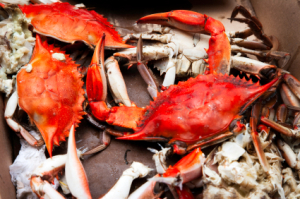
Flicking through the recipe books in search of something special for a friend’s birthday dinner the other week, I happened upon Damien Pignolet’s crab soufflé. But I soon grew daunted by the gazillion steps, and then breathed a big sigh of relief when I remembered one of our guests can’t eat gluten, as the soufflé had flour in it. Then another idea struck: crab mousse! Retro enough to be surprising – or possibly raise a laugh – but I figured it would also involve just enough velvety lusciousness and feel-the-love effort to make a birthday girl feel special.

Next step, hello internets. My friends, there are so many bad recipes online, have you noticed? Obviously there are squillions of brilliant ones too (*bats eyelashes*), but lordy me. Google ‘crab mousse’ and you will find yourself immersed in more lists of cream cheese, powdered onion soup, gelatine, emulsifiers and other icky goop than you can poke a whisk  at.

Happy was I, then, to find this baked crab mousse recipe from  Tamasin Day-Lewis. But never having baked such a thing as mousse before I decided, most uncharacteristically, to give it a practice whirl a few days before the birthday do. Usually I don’t bother practising, being blessed with forgiving friends who are usually happy to be experimented upon and whose manners are impeccable even when served less-than-fabulous meals (Ms A, I’m thinking particularly of you and the grass-clippings chicken a short while ago – you were a model of composure).

Anyhoo – in this instance practice was a good idea. The first time I made the recipe I kept the oven at its standard fan setting, but it was too hot. I also used the recipe’s method of covering each mousse with greaseproof paper but that was a total dud idea for us, as the paper simply curled up, and given the hot oven the thing began to brown round the edges, which is not what you want on a delicate, pale, crabby moussy thing like this. Also, served after five minutes as recommended was way too hot. And finally, presentation-wise it tended to look a little wan and needed a bit of bling. However, the texture was not bad and the flavour was good. So good. So very good.

On the second attempt – birthday dinner day – everything went swimmingly. I used foil to completely cover the ramekins instead of the paper; I turned the fan function off on the oven; I cooked the mousse a little longer and let them cool for longer in the pots. And as a garnish I added a blob of creme fraiche with torn dill and a teeny dollop of caviar. And I am here to tell you it was good. The birthday girl loved it and so did we.

Baked crab mousse with dill & caviar

Adapted from Tamasin’s Great British Classics

Serves 6

Ingredients

  • meat picked from body & claws of 4 cooked blue swimmer crabs, or about 250g crab meat
  • 4 eggs, beaten
  • 400ml thickened cream
  • 4 tsp dry sherry
  • 2 tsp Dijon mustard
  • biggish pinch cayenne pepper (be careful – taste at half a pinch first)
  • 2 tbsp finely grated Parmesan
  • 6 dollops of creme fraiche
  • a few fronds of dill
  • caviar or salmon pearls
  • salt & pepper

Method

1. Preheat the oven to 170C. If you have an adjustable fan setting, turn it off or to lowest setting.

2. Lightly grease 6 small ramekins.

2. Puree crab meat, eggs, cream, pepper, mustard and sherry until smooth.

3. Stir in the Parmesan and season to taste.

4. Spoon the mixture into the prepared ramekins and cover each with a round of aluminium foil.

5. Sit the ramekins in a roasting pan and pour enough near-boiling water into it to come halfway up the sides of the ramekins.

6. Bake for 25 minutes and check. If they are still very wobbly in the centre, keep cooking for another five or ten minutes. The centre should be just lightly set.

7. Remove pan from oven and leave on the stove top, leaving ramekins covered in the water bath until ready to serve. I left them sitting for a little over an hour, and the temperature was perfect – just slightly warm is the perfect temperature.

8. Remove foil lids, wipe away any condensation from the rims and top each one with a dollop of creme fraiche, a tiny spoonful of salmon pearls or caviar and a teensy frond of dill.

9. Serve with champagne & teaspoons.

In this case, practice made (almost) perfect, and I’m glad I did the test run. I doubt I’ll take up testing recipes first on a regular basis – who can be bothered? – but would love to know if you do. Are you a routine practiser or do you use your friends as guinea pigs? Any fabulous disaster stories? Do tell.


h1

Mission Impossible

September 11, 2010

When I made a version of Stephanie Alexander’s Crustless Silverbeet, Pine Nut & Olive ‘Tart’ for a friend recently, she recognised it instantly as a picnic favourite that her friend calls Impossible Pie. I have no idea what makes it so impossible, except the fact it’s basically a robust, chunky quiche without the pastry, which I guess leads to the cutseypie moniker. Whatever the reason, Impossible Pie has stuck  in our house, and it’s become a weekend lunch staple that easily feeds a gang of eight.

The original recipe is from this book here, which I still love to death. Stephanie’s version is entirely vegetarian, and very good too, but for omnivores  I have usually added a handful of chopped bacon or pancetta (for as the Empress is fond of saying, “there’s nothing in life that can’t be improved by bacon”). And I think next time I might sling in a few chopped anchovies too.

Speaking of vegetarians, I’ve been having a little Twitter discussion on the topic lately so look out soon for a post on how to make a vegetarian happy. And I’ve decided that as much as possible, from now on I’m including veg options for any recipes here, using this little green V symbol at the end.

Silverbeet Impossible Pie

  • 1 sizable bunch silverbeet
  • olive oil
  • 3 tablespoons pine nuts
  • 3 tablespoons chopped bacon / pancetta
  • 3 tablespoons currants
  • 1 red onion, finely chopped
  • 3 cloves garlic, finely chopped
  • 12 black olives, pitted & roughly chopped
  • 1 tablespoon rinsed capers
  • 5 tablespoons breadcrumbs
  • 4 eggs
  • 200g natural yoghurt
  • 2 tablespoons grated Parmesan
  • a little butter

Method

1. Wash silverbeet & separate stems & leaves.

2. Chop leaves into strips and stems into 1cm chunks.

3. Throw stems into simmering water for 2 mins, followed by the leaves for another 2 mins. Drain and cool under cold running water for a few minutes. Dry in a tea towel or salad spinner.

4. While silverbeet is blanching, toast pine nuts in a little oil until golden brown, then remove and toss into a large mixing bowl.

5. Saute onion and garlic with bacon or pancetta for a few minutes until bacon is crisp and vegetables are soft.

6. Pulse silverbeet a couple of times in a food processor to roughly chop a little more, then add to bacon mix and fry for a few more minutes.

7. Add the vegetables & bacon to the pine nuts in the large bowl, then add currants, olives and 4 tablespoons of the breadcrumbs. Season and leave to cool.

8. In another bowl, lightly whisk eggs and yoghurt together till well mixed, then add to silverbeet mix.

9. Lightly grease a glass or ceramic pie dish and coat the sides and base with the remaining tablespoon of breadcrumbs (add any leftovers to the mix), then plonk the vegetable mix in, top with the grated Parmesan and a few dots of butter.

10. Bake the tart in a moderate oven for 30-40 minutes or until it feels firm and the top is crisp.  Serve warm or cold with a green salad.

V: Just leave out the bacon

h1

Secrets of a corn star

February 22, 2010

Every time I opened the fridge door on Saturday I was accused by three shrinkwrapped corn cobs bought two weeks ago. Food waster! Abandoner! they cried, in their tiny little corny voices.

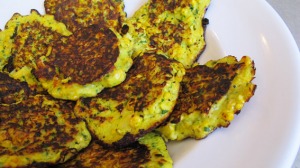
They were a teeny bit worse for wear, and it was lunchtime, and I was home alone. The thought of eating three corn cobs there and then didn’t appeal. But corn fritters did. I checked a recipe and then made my own version according to what I had in the house – using yoghurt instead of ricotta cheese and rice flour instead of ordinary flour. And they were pretty darn good! I ate several and froze the rest.

Then Sunday morning, when Senor was hankering for something luxurious, I whipped up the most fab breakfast in minutes (I was sooo Bill Granger – shame about the non-matching teeth): into the pan went the corn fritters, a few shreds of proscuitto; half a chorizo sausage, thinly sliced; leftover roasted tomatoes. I think it may have been the best breakfast I have ever made.

Corn fritters

  • 3 cobs corn kernels
  • 4-5 tablespoons rice flour
  • 1 tablespoon yoghurt
  • 1 handful each finely chopped basil, parsley, chives
  • 2 eggs
  • 1/2 teaspoon chilli flakes
  • salt & pepper

1. Shuck the corn (don’t you love that word?) by standing the cob on its end and running a knife sharply down the side.

2. Mix everything in a bowl, adjusting the flour if it gets too watery (it does look unnervingly runny, but that doesn’t really matter in the end).

3. I threw two-thirds of the mix in the food processor and pulsed just a couple of times to get a rough blend, then returned to the bowl.

4. Heat some oil in a non-stick pan over med-high heat and cook the fritters in batches. Depending on the amount of oil you use and the runniness of your mix, the texture tends more to the pikelet than fritter, but either is delicious.

5. Drain on kitchen paper before serving.

h1

The ultimate fast food: the omelette

January 21, 2010

Now, I know I banged on at length about eggs not so long ago (by the way, in sad news just to hand Charlotte Chicken just got going in terms of supreme egg production – she was up to double-yolkers, for godsake! – when she and Shirley had to return to their grandpa at Rentachook. Apparently, while much loved, they laid waste to the (not-theirs) garden which now resembles Maralinga or something. Still. We chookless urban dwellers are very sad to see them go.)

Anyhoo, I just wanted to bang on a little bit more about eggs – specifically, the joys of the omelette.

The thing is, if you can believe it, until two months ago I had never in my life made an omelette – and then I did, inspired by this Julia Child TV demo. But now I know how seriously fast and fabulous this little baby is, I’m slinging one into the nonstick pan twice or thrice a week for lunch.

Now, as you’ll see on the video Julia goes nuts with the butter – as she is, of course, obliged to do – and uses three or four eggs per person (mmm). But it’s just as good with a teensy bit of olive oil, and I’ve gotten used to two eggs plus tossing in whatever is to hand – fresh tomato, a little bit of grated Parmesan, lots of chopped herbs, salt & pepper.

But be warned – omelette making is a superfast and furious game. I’m talking about a single minute in the pan, so you gotta have everything ready to go before you chuck the eggs in. But do watch the video for the joy of Jules as much as the excellent pan-shaking technique.

I never get the thing to slip and slide out so elegantly the way she does, of course – I just use a spatula to fold and flap and scoop it out any old which way. It’s still divine.

h1

Loaves and fishes: my list of miracle foods

December 15, 2009

Okay, I know Christmas isn’t strictly related to that particular miracle (reminds me of the time my heathen brother-in-law demanded of my mother what the hell Easter eggs had to do with Jesus being born in Bethlehem anyway…), but one of the things I really like Christmas & New Year holidays is the tendency toward spontaneous and sprawly gatherings over food.

You know the kind of thing, two people for lunch turns into ten, and an instant party ensues. But to make that kind of thing fun it’s gotta be stress free – so here’s my list of good stuff you can pull out at the last second for lunch or picknicky dinner, or take to a friend’s place to blast off their Christmas stress.

Some are old summer holiday faves, and some gleaned from these pages this year. Most of this stuff can be bought in advance and shoved in the fridge, freezer or pantry to pull our for miracle-working when requried…

  • Oysters - of course! Buy them unopened a few days before Christmas and keep in a bucket with a wet towel over them in a cool place – they keep for a couple of weeks.
  • Glazed ham – leftovers, for weeks. Mmmmm.
  • Chutneys & pickles - years ago the Empress introduced me to the killer recipe for Christine Manfield’s eggplant pickle.
  • Smoked salmon – or Virginia & Nigella’s cured salmon! – w creme fraiche and/or salmon roe & sourdough
  • Smoked trout –  keep a couple in the freezer and pull them out any old time
  • Cooked prawns, green salad, mayonnaise
  • Bread – keep a supply of sourdough in the freezer
  • Green salad, nicely dressed with good oil & vinegar
  • Chickpeas – of course! Chuck em in a bowl with bottled roasted capsicum & marinated feta or labneh, or try these ideas
  • Baba ganoush & Steph’s beetroot dip – plus packets and packets of rice crackers
  • Quinoa salad or citrus couscous (make a huge batch – both of these keep forever)
  • Lots of luscious, ripe avocado – buy a heap of those rock hard ones now to have softies on hand for later.
  • Lots and lots and lots of ripe tomatoes
  • Devils on horseback – everybody loves them! And you can keep sealed pancetta & pitted prunes on hand for months…
  • A couple of fillets of salmon in the freezer and a couple of spuds can yield a heap of salmon patties for a crowd.
  • Peas! I am never without a huge bag of frozen peas in the freezer. Actually there will be a new post on peas coming shortly…
  • Eggs – chuck a few halved, hard-boiled eggs in a green salad with some chunks of fresh, cured or smoked salmon and you have a delicious twist on nicoise.
  • Labneh - mmmm.
  • Quiche - if you have frozen shortcrust pastry in the freezer, a quiche takes about fifteen minutes to throw together and another twenty to cook. Fast and fab.

Okeydokes, that’s Santa’s (or Jesus’s?) list of magic expandable food for now – but you must have lots of things to add …

*Oh, and today’s Christmas Excess Antidote is courtesy of www.kiva.org- I absolutely love this site. At the click of a mouse you can provide a micro-loan (as little as $25) to someone in a developing country who’s making a go of things with very slim pickings indeed. I love it so much because your loan just keeps on giving – you can either get the money back (though what kind of a person …) or choose that it goes to someone else in the chain. Perfect!

h1

The chicken and the egg

December 8, 2009

During this last week I have been bestowed with one of the greatest honours of my life. Booker Prize, you ask? Bip-bow. Pulitzer? Shmulitzer. Miles Franklin? Huh – that old rag!?

Nope – this week, I had a chicken named after me.

That’s right, read it and weep, non-chicken-namesakers.

My friend Mistress Alice of the Mountains, aged eight and a half, and her brother Paddy, four and a half, are the proud new carers of two lovely chooks from the increasingly famous and brilliantly conceived Rentachook, where you rent chooks and coop for six weeks on a try-before-you-buy basis, so you can see if chicken-human cohabitation suits you both.

And I am told that on the journey home to the mountains with the chooks in the back of the car, Paddy and Alice pondered on the names for their new friends. By the time they reached home, Paddy’s chook was named Shirley, and Alice had chosen Charlotte. Both fine chook monikers, I’m sure you’ll agree (although Monica would have been nice too?), and I am assured by Mistress Alice’s parents that Chicken Charlotte genuinely is named for me and not some schoolfriend competitor for Miss A’s affections. Strange but true.

I am more chuffed than I can say. And here she is, above. Has there ever been a more beautiful specimen of chook womanhood?? Read the rest of this entry ?

h1

Golden delicious

October 31, 2009

poachedeggHow to poach an egg

It’s the weekend. The weather is perfect. And in our house the breakfast cook is not me but Senor. The discrepancy between our skills with an egg became clear many years ago; he is the undisputed breakfast champion, which suits me perfectly (to say I am not a morning person is something of an understatement.)

Poaching an egg, I believe, is one of the most delicate and highly-skilled operations in the kitchen, and in my opinion the world is divided into two classes – people who can poach an egg and those who can’t. I am in the latter category; whenever I have tried I end up with a pan full of watery skeins of disintegrating egg white and a hard-yet-sodden little grey ball of yolk.

But Senor has developed the art of egg-poaching to perfection – the white is always just cooked through and perfectly un-drippy on the toast, and the yolk holds its shape before oozing gorgeously when cut.

So because I love you all, I hereby present Senor’s egg-poaching technique, dictated to and faithfully transcribed by yours truly.


  1. Take a non-stick frying pan & fill with about 5cm cold water. Make sure the pan is wide enough to poach a couple of eggs without them touching each other.
  2. Place pan over medium heat and immediately, and very gently, crack eggs into the water, making sure the white does not disperse too much.
  3. Now you play the waiting game. Use this time to make the toast and butter it.
  4. Occasionally test the firmness of the eggs by gently swishing the water near them to determine the wobble factor.
  5. When the egg is not quite as cooked as you like it, carefully remove it from the water with a non-stick slotted spatula, tilting the spatula for a few seconds to allow water to drain off. The whole egg-cooking procedure should take around 7 or 8 minutes.
  6. Carefully place the egg on your buttered toast – the egg will continue to cook as you bring it to the table. Best bread is Turkish or sourdough because it has crevices and holes for the  soft yolk to pour into without making the bread soggy.
  7. Best served with the Empress’s tomato oil pickle … Unless she hasn’t given you any for a while ... quite a while …


Follow

Get every new post delivered to your Inbox.

Join 139 other followers