 As any visitor here will know, the sharing of food is one of the great joys of my life - but I don’t think we’ve ever really talked about the whys and wherefores of actually sharing recipes and ideas for dishes. It seems self-evident that folks who read - and write - cookery blogs have a natural, internalised desire to share knowledge and ideas about cooking, so it has always stunned me when people talk about having “secret” recipes.
Secrecy over recipes and the fierce withholding of kitchen expertise plays a central role in the film Toast, the dramatisation of Nigel Slater’s memoir of the same title (I’m assuming the same events occur in the book) . From Slater’s Wikipedia page:
[Slater] used food to compete with his stepmother – the former cleaning lady – for his father’s attention. Their biggest battle was over lemon meringue pie – his father’s favourite. His stepmother refused to divulge her recipe, so Slater resorted to subterfuge in order to turn out his own version. “I’d count the egg-shells in the bin, to see how many eggs she’d used and write them down. I’d come in at different times, when I knew she was making it. I’d just catch her when she was doing some meringue, building up that recipe slowly over a matter of months, if not years.”
Whatever the truth of Slater’s step-mum’s kitchen caper might have been, his portrayal of her represents a figure some people know well. I wonder if this kind of woman - always a woman in the stories I’ve heard - is still around, or is she only a figure of bygone eras, when a woman’s power in society was so limited that she felt she had to wield it in this manner?
Or am I inventing this Fifties Femme?
My own mother couldn’t give a damn about who had her recipes, but then she was never a particularly passionate cook to begin with. Unlike a friend’s aunt, who staunchly refused for decades to share the recipe for her legendary melting moments. Eventually, suffering a brief attack of magnanimity, Aunty Mean deigned to offer the recipe to her niece, a brilliant cook - but only on the proviso that she promised never to share it with her mother! Rather takes the cake (boom-tish) for sibling rivalry, don’t you think? My loyal friend politely declined the offer, managing not to add, “It’s only a fucking biscuit!”
The holding of recipe cards close to the chest in this way speaks of all kinds of things that have, obviously, nothing to do with the biscuit. It implies that cooking is a contest, that the only value in making beautiful food for others is in your power to impress them, and indeed that one’s esteem in the eyes of others is so fragile that refusal to share something as trivial as a recipe will actually help maintain that esteem. When of course it just does the opposite - paints you as desperate rather than skilled, mean-spirited rather than generous. In fact the whole concept of generosity is completely absent in this kind of syndrome. As well, when all recipes spring from other recipes, it seems somehow dishonourable to suggest that my recipe alone is original, and therefore so much more valuable than yours. It also smacks of a lack of confidence about the bounty of creativity - this recipe is so precious because there will never be others to take its place. I’ve known writers like this in my time, who obsessively, vigilantly - and in vain - inspect the work of others for similarities to theirs. What such people seem not to understand is that this fearful obsessing over other people’s wells of creativity means that their own will always be in danger of drying up completely.
Anyhoo, I’m happy to say that among my friends and family, recipes and food ideas fly back and forth and round and about with complete abandon. Take the unbelievably good lemon curd fool we ate at the Empress’s palace last week, which I then immediately pinched for our dinner guests on Saturday night. It’s one of the easiest, quickest and yet most swooningly striking desserts you’ll ever try. Bizarrely, I had never made lemon curd until that day but now I know how easy and how very fine it is - my favourite meld of citrussy tartness and sweetness - I’m going to find many other desserty avenues for it.
Which brings me to another part of the pleasure of sharing recipes; one leads to another, which then morphs into another which gives birth to another and another, in a rich cycle of generosity, abundance and plenty. And as soon as I “invent” - or am given! - a suitably delicious new incarnation of this luxurious dessert I’m inviting the Empress over to eat it.
 Lemon curd fool
- Make a lemon curd - I used the recipe in Stephanie Alexander’s The Cook’s Companion, but there are thousands about - and let it cool, then chill (I made ours the day before).
- Whip some cream into stiff peaks - from memory I used 300ml pouring cream for a curd of 1.5 times Stephanie’s quantity.
- Mix the two together - that’s it! Simplicity itself.
We served ours in small glasses with a sploosh of passionfruit pulp on top of each one. The Empress had a wafer of home-made biscotti sticking out of hers. I can imagine all kinds of lovely toppings and additions - crumbled pistachios maybe, or a little finely chopped mint?
Love to hear your tales of recipes shared or protected. Do people still refuse to share recipes? Or, as women have actually begun to take part in the world beyond the kitchen, has such desperate recipe-protection become a thing of the past? And I wonder if the syndrome has arisen among men as they begin to take up more space in the kitchen? Or am I looking at this whole thing from the wrong point of view? Is there any virtue in keeping “secret recipes” that I’m overlooking?
And if you have a favourite use for lemon curd, do share ……

 On the weekend, along with another crack at the char-grilled octopus (a big hit with the punters, it turns out, specially served with aioli) I revisited this old Karen Martini recipe for haloumi and roasted garlic wrapped in a vine leaf and served with peach.
 You may remember that in the past couple of years, the Empress and I have had the onerous duty of judging the annual
 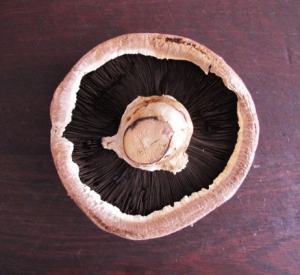 The last entirely vegetarian dinner party I cooked was a wintry little number, but very satisfying, with a few nicely contrasting elements I think. The mainstay was a mushroom ragu served on creamy polenta, paired with a side dish of a punchy green salad with lentils & goat’s cheese.
  Heat oil & add celery, carrot, onion, garlic and some sea salt, sauté until soft.
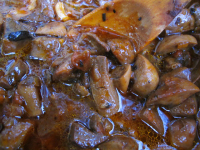 Not long before you’re ready to serve, make
 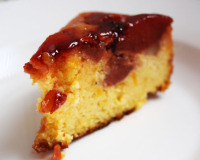 Sweet ending
 Till now, my appreciation of
  Karen Martini’s vine-leaf wrapped haloumi with peach
 About mid January each year I start stalking the grocery shelves for figs.
 Inspired by Fiona’s comment about Indian food yesterday, plus the fact we had been given two kilos of beautiful Killcare cumquats by our friends the Nannas of Naremburn, I messed around with a few chutney recipes and came up with this spicy Indian-style cumquat chutney.
 The original recipe called for currants; I had only a handful of currants in the larder but lots of barberries, the tart little rubies I found on our
  Throw everything but the lime juice into a heavy-based saucepan, reserving a little of the sugar and salt until you taste it at the end.
 One of the best reasons for having a proper food writer as a friend is joining them for the spontaneous suburban sojourn in search of a particular dish or ingredient.
  My husband recently returned from a visit to his mum, Annie, bearing
  Further to our earlier discussion of
  subscribe
 How to shuck an oyster