Archive for the ‘summer food’ Category

h1

Jewel in the crown

January 29, 2013

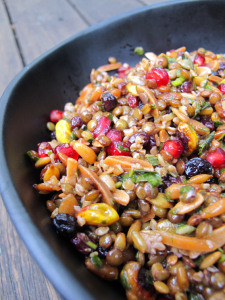
Jewellery box saladHave you noticed how certain dishes can end up defining a time or a season in your memory?  In our house this seems especially true of salads, and of summer.  In the past we’ve had the Summer of Quinoa, and the Summer of Citrus Couscous (the latter remaining the strongest food memory of a road trip we took with dear friends to Perth and back over a decade ago, camping and couscous-ing all the way).

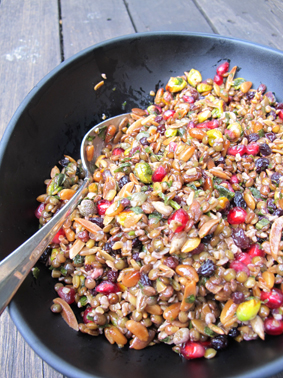
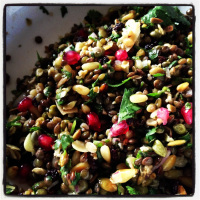
Well this summer of 2012-13 will most definitely be remembered as The Summer of the Cypriot Salad. Or maybe the Jewellery Box  Salad, as I’ve come to think of it. It’s so beautifully colourful and baubly to look at, I find myself gazing adoringly at it almost for longer than I spend eating it each time. It’s also become fondly known as the Freaky Salad because it uses freekeh (the nutty and chewy green cracked wheat which can be found in some health food stores, but can be quite difficult to get hold of ).

In my last post I think I mentioned how much we loved Hellenic Republic’s ”Kipriaki salata dimitriakon – Cypriot salad of grains, pulses, nuts, yoghurt” that we ate during a visit to Melbourne in December.  I couldn’t stop thinking about it even days after we got home; the sign of a great dish, don’t you think?

A hunt around the internet yielded this recipe. However, the ratio of lentils to freekeh here didn’t really match my memory (or preference) so I tweaked it a bit to come up with an ever-changing version that we’ve made over and over. The restaurant version included a dollop of yoghurt and, I think, some cumin, both of which are delicious additions although I have tended not to bother with either over time.

It’s the kind of dish where quantities hardly matter, to be honest, so you will find your own way with whatever you have to hand. The only non-negotiable essential is the puy lentils, I think – and although I have made it without the pomegranate seeds, it is so very much better with them that I’m not sure I’d bother going without. The pumpkin and sunflower seeds are also quite necessary for the salad’s lovely surprising crunch.

This dish has two huge advantages apart from being swooningly good to eat. First, it keeps in the fridge for days and days and days without any noticeable fade in quality, and it is incredibly filling. I discovered just how seriously so for both factors  when we made a huge amount for a lunch party and then spent the entire rest of the week eating the leftovers for lunch and dinner.

So here we go – all quantities are debatable; I generally chuck in a handful or so of whatever I feel like. I do prefer a lentil-freekeh ratio of around three to one, even four to one. I find the salad can get a little gluggy if there’s too much freekeh. I have also very often used a handful or two of wild rice in its place, which works just as beautifully and has the added advantage of being fine for gluten-free folk.  This quantity should work for at least six people, but don’t quote me until you’ve tested it for yoursel

freakysalad2Jewellery Box Salad
viaHellenic Republic

  • Juice 1 orange
  • Olive oil
  • ½ cup currants – or combined currants, dried cranberries, raisins
  • ¼ cup capers, rinsed
  • 1 cup puy lentils
  • ¼ cup freekeh or wild rice
  • 1 cup nuts – pine nuts, pistachios, slivered almonds are nice
  • ½ cup mixed pumpkin & sunflower seeds
  • ½ bunch parsley, finely chopped
  • ½ bunch coriander, finely chopped
  • Juice ½ a lemon
  • Seeds of half a pomegranate
  • Salt & pepper
  1. Soak the dried fruit and capers in the orange juice while you prepare the rest of the dish.
  2. Cook the lentils and freekeh or wild rice separately in boiling water until just tender – I cook the lentils for about 15 or 20 minutes and the freekeh or rice for longer; you want them to retain a tiny bit of bite while still being properly cooked.
  3. When lentils are cooked, drain and then immediately sloosh with some olive oil and salt to give a nice glossy coating and stop them sticking. Add the grain or rice when drained and stir well.
  4. While that’s happening, toast the seeds and nuts in the oven or on the stove top – the usual advice about not looking away applies! If any of them really burn, throw them out and learn your lesson – the bitterness of burnt nuts will taint the whole dish.
  5. Remove the seeds from the pomegranate making sure to avoid the pith – the easiest method is the satisfyingly violent one detailed here.
  6. When the nuts are coolish, chuck all ingredients into a bowl and mix gently but thoroughly. Add more lemon juice or olive oil to taste, season well  and present with a flourish.

Now your turn – what’s been the defining dish of your summer so far? Any favourites to share?

h1

What I ate on my holidays

January 18, 2013

Salad days

It’s been 46.2 degrees Celsius here in Sydney today – that’s over 112 degrees for you Farenheit fans – at the end of my first week back in the office for a loooong time. Luckily this room is air conditioned  unlike the rest of the house, but I’m wondering what on earth to cook for dinner. Last time it got nearly this hot I made this, but I think I have a batch of Karen Martini’s amazing Syrian chicken in the freezer, so I think we’ll have that (actually it’s ours, not Karen’s – but the recipe is hers…)

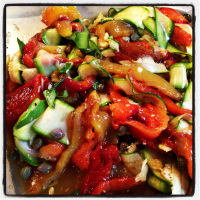
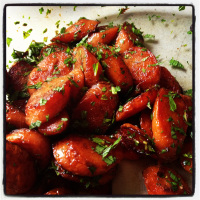
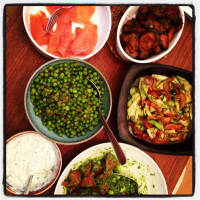
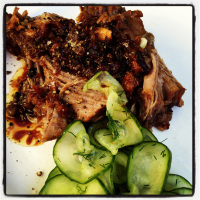
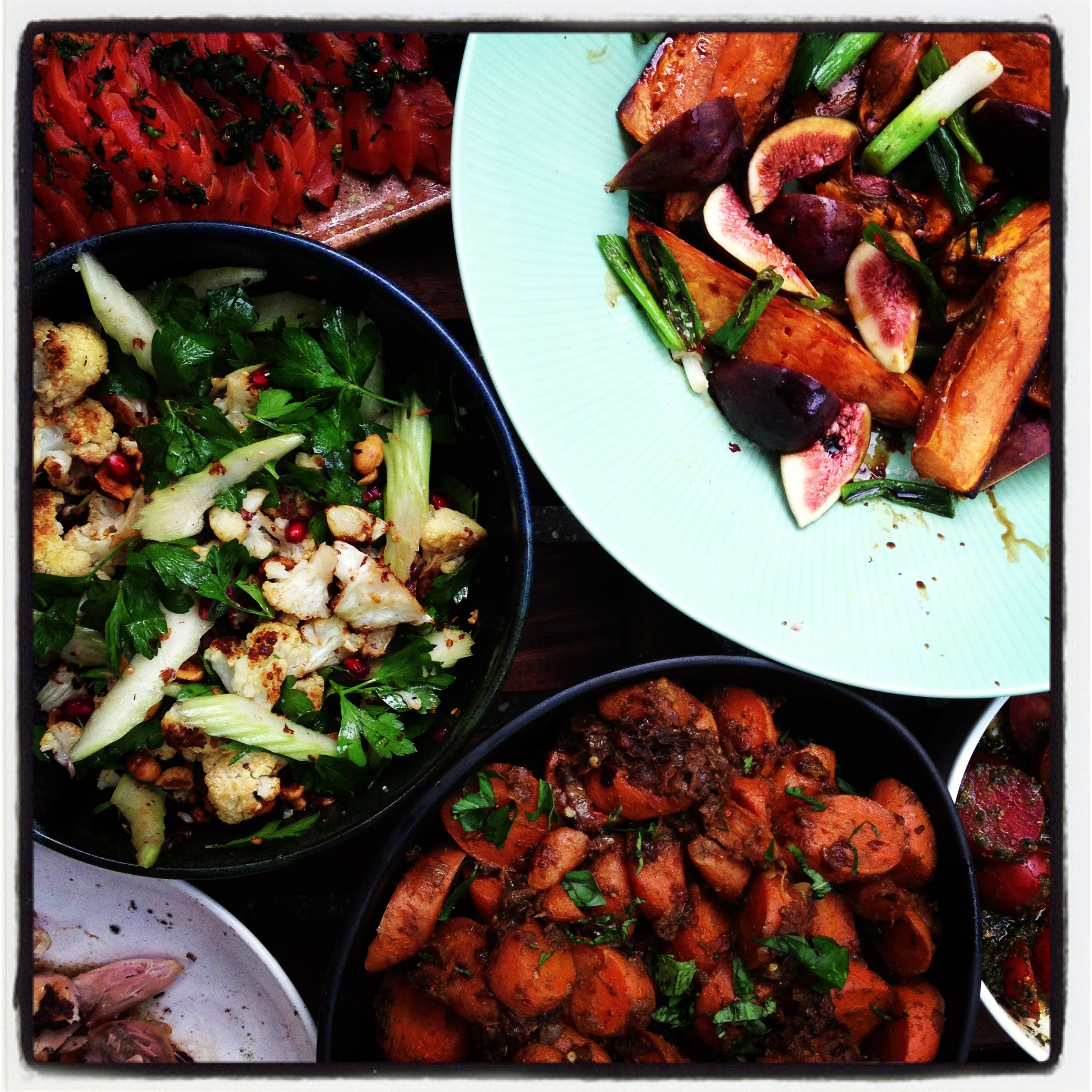
January has been perfect salad weather so far. So in lieu of a very, very overdue posting – and just before I go and find a cooling bevvy in the fridge – I’ve decided instead of writing here I will merely present a pictorial history of my favourite bits of holiday cooking and eating. Salads, salads, salads and more salads, with the odd bit of protein thrown in. Have been inspired again by the wonderful Ottolenghi lads, as I was given this fantastic book for Christmas, but also have revived lots of old favourites. Hope to be back here soon with some recipes … if you’re in Australia, stay cool folks!

Oh look, the cool change is here! Aaaaahhhh….

h1

The Veg Report

February 4, 2012

It seems a bit early to report on my first week as a vegetarian seeing as it’s actually only day four of our VegFeb month, but what the hell.  I am already finding it an interesting experience.

Day one was – well, a great big veg fail, because I omitted to read a menu properly.

Senor and I were at Sydney Theatre Company to see Never Did Me Any Harm (which we loved – I thought it was a beautifully original production and I loved the slipping and sliding narratives and use of dance and text as well as speech) and sat down for a quick bite from the cafe menu there at the Wharf.

I ordered while S found a table, and I found some good veg stuff on the menu including a mushroom bruschetta with shaved Parmesan, an oxheart tomato bruschetta, some warm olives and a fig & goat’s cheese salad. The bruschettas & olives were very good (although it’s lucky we are including anchovies in our almost-veg adventure, as unbeknownst to me some big fat delicious ones were in the tomato & pesto mix).

When the fig salad arrived, S looked at me as if I was crazy. ‘What are we going to do about that?’ he asked, pointing at the plate. There were a few halved almonds dotted over the dish. I put on my special Patient Voice and said, ‘Sean, nuts are fine for vegetarians.’

Then it was his turn to employ a special Voice for the Stupid:

‘I’m not talking about the nuts, I’m talking about the pig.’

And there it was – four large, pink and curling satiny ribbons of prosciutto nestled among the figs and the rocket and the goat’s cheese. How could I have missed reading this on the menu? And how did I miss seeing it on the plate!?? And why did I even think figs would be served without some kind of cured pork – especially given that it’s a particular favourite combination of mine?

If there had been a non-vego at the table it would have been easy – just make them eat the prosciutto and forge merrily on. But now we were faced with the dilemma – knowing that restaurant rules would surely mean this beautiful stuff was thrown away if we didn’t eat it, or sticking to our VegFeb plan. Of course we ate it, and it was delicious.  But it was an interesting lesson in how much more carefully I need to be reading menus in the next little while. I can’t bear the idea of being one of those people who sits asking waiters about every ingredient in every damn dish, though. Which is probably one of the reasons I know I’ll never be an actual vegetarian. But I will be more careful about thoroughly reading, rather than quickly scanning, menus for the rest of February. And we have added a new rule – if we eat meat due to menu stuffups like this one, or to be convivially polite at a friend’s house, then we add another day at the end of VegFeb. Easypeasy. (Which reminds me – mmmm, peas…)

But the rest of the week has been fun, and lordy we have eaten well.  The day after VegFail (at least I know I’m not alone. A pal of ours, also doing a VegFeb version but stricter – i.e. no anchovies – was forced to eat meat on her day one, when the burger restaurant where she’d arranged to meet a friend offered no veg options, which seems pretty hopeless!) we had several folks round for dinner. I marinated and roasted some chicken pieces for them, which we served along with:


And followed with a traditional Middle Eastern orange cake with yummy sweetened labneh.

The leftovers from these kept us going for lunches for a few days. Dinners this week have also included this chickpea & cashew curry, and this very tasty silverbeet tart, minus the bacon and plus some sunflower seeds as well as the pine nuts.

After a few days I jumped on the scales, curious to see how quickly my new meat-free existence was sending me to Svelte City – and I’d put on over a kilo. Hmmm.

This salad was one I made last weekend prior to official VegFeb start, inspired by the fantastic recipes in Heidi Swanson’s book Super Natural Every Day (I’ve now bought three copies of this book for friends as well as my own, for the originality and big flavours in the recipes) and the first Ottolenghi book, both of which I love to death. One thing I’ve noticed with both these books is how often vegetables for roasting are cut into quite small pieces – which is of course fab for getting that lovely fat and crispness to a lot more surface area, especially with otherwise quite soft veg, not to mention a greater caramelised flavour through the whole thing.

So this salad was basically a matter of using a quarter of a pumpkin and an eggplant from the fridge, both of which were starting to fade. And I had just stocked up on lots of nuts from the farmer’s market. As I sort of made it up as I went along I don’t have a proper recipe, but from memory these things went into it. Quantities don’t really matter in a thing like this, obviously – whatever you feel like doing works.

  • pumpkin, skin on, chopped into 2cm squares & roasted in a light spray of olive oil in a hot oven for about 20-30 mins or till caramelised
  • eggplant, ditto
  • pine nuts, lightly toasted
  • pistachios, lightly toasted
  • pecans, roughly chopped & lightly toasted
Once these were cooled and tossed together, I made a dressing of
  • maple syrup
  • olive oil
  • orange juice
  • 1 garlic clove, finely chopped
  • a splash of balsamic vinegar
  • chilli flakes
To be honest I think the dressing was a bit too acidic, so would probably do something about that next time. But it was still damn fine, and a bit of chopped coriander over the top finished it off nicely. We took some of that and a bit of other stuff round to some friends who had just moved house, so they had something other than takeaway to eat among the boxes that evening, and everyone was happy.

Now, I now you’re all great cooks with some fab veg recipes in your repertoire – don’t forget to point me to any particular favourites as I progress through the month.  I’m already excited about a couple of new things I’m trying this week – I’ll be back with further reports soon.

Oh, and PS: Just in case you’re interested, I have a piece on why and how I came to love oysters in the new (March) issue of SBS Feast magazine, which I believe is in the shops on Monday. I haven’t seen the final version yet, but because it is a kind of oyster love story it includes a photo of me and my beloved shucking oysters at our pals Jane & Brian’s place at New Year, which is kind of nice. Thanks to B for taking the pic. 
h1

Fish out of water

January 27, 2012

Our (almost) vegetarian adventure

Some of you already know about the culinary experiment I am forcing on Senor for February – the two of us are going veg for a month.

Last year it was Febfast, giving up the booze, which was a chore, to say the least. I expect to enjoy this February a whole lot more than last, for I have no doubt we will be eating very well indeed.

We’re trying out a version of vegetarianism for a few reasons, apart from my increasingly obvious lapsed-Catholic attachment to some annual ritual festival of denial – any other ex-Catholics out there with these weird lenten leanings?

First, I just want to see what it feels like to go without meat for a month, because I realised some time ago that I have never forgone meat (either red meat, or chicken, pork, bacon, chorizo, fish, seafood etc) for even one week, let alone a month. And even though I feel that we have cut down our meat consumption substantially, I took note of everything we ate while away last week – a holiday filled with delicious salads and veg dishes provided by excellent cooks – and realised that even then, not a day went by without some bit of animal flesh – fish, or ham, or chicken. So actually, the only thing we’ve really cut down on is red meat.

Second, I am hoping it will help us shift a few kilos of the blubber that returned rather insistently over the latter quarter of the year. As I said to Senor, I’ve never known a fat vegetarian, my eyes glazing over and mouth watering with images of all the butter and cheese (and organic ghee kindly delivered to our door by our friend Guy the other day!!) that we will be chowing down on. And then Senor most unhelpfully pointed out that we do know a couple of portly vegos, which sort of ruined my fantasy of the kilos dropping daily with zero effort on our part at all. But I still will be interested to see how it affects weight and general health and feeling of zinginess, to substitute meat with other things.

Third, I am keen to see what kind of a reboot my cooking repertoire receives from this change in routine. When I’m busy I, like most of us I’m sure, tend to fall back on the usual contenders for the evening meal – but this will force me to try new things and extend the range a bit, I hope. As well, one of the things I’ve always believed is that to make interesting, really flavoursome  veg food requires more effort than a meat diet does. And now I’m a full-time student (starting a PhD in Creative Writing, eek) I will be financially less well off but have more time and flexibility. If there is ever a time to do this, it’s now – in summer when salads are inspiring, when one doesn’t crave rich, stodgy food as I do in winter, and early in my studies when I can retain the illusion I have plenty of time to do everything.

Finally, there will be the nice fuzzy glow of knowing we’ve spared the lives of a few critters, but I can’t pretend that this is really high on the list of reasons. While in recent years I have thought a lot about my love of meat, and eating it has caused me guilt and unease, I have recently come to a position of moral acceptance that it’s okay to eat animals that have been humanely raised and which have not been made to suffer unnecessarily (hence shopping at Feather and Bone, and proper free range eggs and chooks and all that jazz that you probably all do as well). We’ve cut down a lot on red meat, as I’ve said, and become much firmer in a commitment to real free range pork and chicken (I think conventionally raised lamb and beef, in this country, have better lives than they do in wholly grain-fed operations like those in the US, and have better lives here than our pigs and chickens do, even accounting for beef being finished on grain), but we also try now to only buy red meat from either F&B for that reason. I do welcome any commentary on this, by the way, because I am always keen to hear more about ethical meat production.

All that said, and in noting that we’re only going veg, not vegan, we’re doing this with a few caveats in place.

The first and most important for me is that, while we’re telling all our friends and family about this trial and some have already booked us in for veg meals with them, we won’t be refusing meat at someone’s house if it feels rude to do so. Given that this is an experiment rather than a life choice, I won’t be imposing our vego status on our friends. And to me, conviviality and respect for the person who offers you food is as ethically important as respect for the life of an animal, as the fabulous Tammi Jonas has written about so eloquently here.  So there is bound to be the odd evening we eat a bit of meat rather than reject someone’s hospitality, though we’ll try as much as possible to minimise the chances.

Second – and this has no ethical basis whatsoever – I can’t give up anchovies. I just can’t. I love those little salty bombs as much as bacon, which I know I really will miss, for a hit of flavour in everything from chickpea salads to lamb roasts to onion tarts to antipasto. I completely accept the hypocrisy of feeling warm and fuzzy about a cow but not a fish, no matter how small. I hope I have never claimed to be free of hypocrisy (one of my favourite lines on hypocrisy is this, from the philosopher and psychologist Jonathan Haidt: “Stop smirking. One of the most universal pieces of advice from across cultures and eras is that we are all hypocrites, and in our condemnation of others’ hypocrisy we only compound our own.”  That came to me via Hal Herzog’s wonderful book Some We Love, Some We Hate, Some We Eat: Why It’s So Hard to Think Straight About Animals).

So now, in honour of our beloved salty little fishy bombs, and in farewell to meat for a month, I offer you this recipe which includes anchovies. It’s a very slight adaptation of a Neil Perry recipe from Good Weekend some time ago, and it is excellent. He used blue eye trevalla but as there was none when I went to our local fish market I bought royal basa and it was good. That said, next time I would try harder to buy a more sustainable fish, given the bloody ethical minefield that seafood shopping entails (god it’s tiring, isn’t it?).

I added chickpeas and zucchini to this to make it a serious one-pan dinner of gorgeousness. I also used dried rather than fresh oregano (just a teaspoon). Highly recommended with or without those additions.

This will be the last fleshy recipe from me until March – but I hope to be posting at least a few updates of how we’re faring throughout vegetableFeb.

Neil Perry’s Roast blue-eye trevalla with fennel & olives
  • 1 bulb fennel, finely sliced
  • 1 red onion, finely sliced
  • 2 tablespoons oregano, chopped
  • 2 tablespoons thyme, chopped
  • 60 ml olive oil
  • 1 red capsicum, finely sliced
  • 4 tomatoes, chopped (NP peels and deseeds, but I am too lazy for that and almost never do it)
  • 2 tablespoons capers, rinsed and drained
  • 6 anchovies
  • handful of olives
  • 1 tsp chilli flakes
  • 1 cup white wine
  • 4 x blue eye trevalla fillets – we used basa, but any firm white fish fillet would work
  • 2 tablespoons chopped parsley (I forgot this but it mattered not)
  • Additions: 1 can or equiv cooked chickpeas; 2 small zucchinis, chopped into 3cm lengths
  1. Preheat oven to 200 degrees C.
  2. Toss fennel, onion, herbs, capsicum, tomato, capers, anchovies, olives, chilli flakes together in a roasting tin. Pour the wine in and roast for about half an hour, or until the vegetables are soft.
  3. Add the chickpeas and zucchini and return to oven for 20 minutes or so until zucchinis are just tender.
  4. Nestle the fish fillets into the mix, drizzle with a little more oil and return to the oven for about 10 minutes or until fish is just cooked.
  5. Remove tray from oven, leave to rest for about five minutes and then serve a fillet on each plate, topped with the vegetable mix, garnish with parsley and season.

Any of you ever done the vegetarian thing? I’m very interested to hear about it if you have, and if you still are, what kind of foods you missed when you first gave up meat – and if you went back to meat, what tipped your decision…

h1

A cool change: heatwave cooking

February 17, 2011

Well, the first real heatwave of the summer hit us with full force on the first weekend in February. I have never felt so hot in my life as I was that Saturday, when the temperature where we were, at beautiful Killcare just north of Sydney, reached 42 degrees Celsius (that’s over 107 F) for most of the day. According to the weather boffins, it was the sixth successive day that the Sydney area had reached sweltering 30-plus temperatures, representing the hottest week in 150 years. Pheeeew….

Sharing a beach house with some friends would appear to be the best thing to do on such a weekend, but that Saturday even the sea breezes worked like an oven’s fan. We swam, once or twice, but the sand was so hot the only way to deal with it was to run, full-pelt, with shoes on, to the water’s edge or risk significant burns to the feet. Then it was a matter of staying in the water for as long as possible, then doing the bolt back across the sand to the car. Our strategy for the rest of the day was to lie around in our bathers, periodically standing under a cold shower and not drying off until the heat forced us back into the shower.

At one stage we were forced to dress and visit the very sweet Hardys Bay RSL club for their air-conditioning, and though the aircon was struggling mightily, it helped for a couple of hours – despite even the club’s fridges breaking down because of the heat, they made do with buckets of ice for drinks.  When we eventually made for home at around 6.30pm the car’s thermometer reported the air temp as a deliciously cool 37 degrees C!

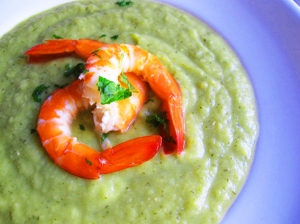
Needless to say, not a lot of cooking took place that day. Luckily, very early that morning before things went crazyhot I had made a pea, cucumber, leek and mint soup, and left it chilling all day. We ate it late that night with cold cooked prawns plonked on top. I think it was possibly the only thing we could have eaten that day with any pleasure.

Not long afterwards, all four of us dragged mattresses and cushions outside to the wooden deck of our little house, doused ourselves from head to toe in mosquito repellent, set up two electric fans and pointed them at ourselves, and tried to sleep. Quite an adventure, and we provided much amusement for passing neighbours the next morning with our little war hospital on the front deck.

Then later that day, a cool change came gusting gloriously in, and we were saved.

What did you eat, if you were in similarly overheated dire straits that weekend? Or if you’re elsewhere in freezing climes, what have you cooked to fight the cold? Love to hear your extreme temp cooking stories.

Meanwhile, here’s the soup – try it next time it’s stinking hot.

Chilled leek, pea & cucumber soup with prawns

A cooling summer lunch or light supper. Unlike many cucumber soups, this one contains no cream but is quite filling. Serves 4

Ingredients

Olive oil

2 leeks, finely chopped

8 Lebanese cucumbers, peeled, seeded & chopped

½ bunch dill, chopped

1 litre chicken stock

½ can cannellini beans, drained & rinsed

1 cup frozen green peas

1 tablespoon chopped mint

12 cooked prawns, peeled (tails left on if desired)

Pepper & salt

Method

  1. Fry leeks gently in olive oil till softened.
  2. Add cucumber & dill and cook for a few minutes.
  3. Add chicken stock, cover and simmer for about 20 minutes or until vegetables are very soft.
  4. Remove from heat, add frozen peas – they will quickly soften & help cool the soup.
  5. Add cannellini beans.
  6. Puree soup with a stick blender or in food processor until smooth or desired consistency – can be rustically thick.
  7. Check seasoning – depending on the saltiness of the stock, salt may not be required.
  8. Cool and then chill in refrigerator for several hours. Can be served at room temperature, but is best served quite cold.
  9. To serve, ladle soup into bowls, top with three prawns per bowl and scatter chopped mint over the dish.

To make this for Vegos, obviously, just skip the prawns and use veg instead of chicken stock. Very refreshing.


h1

The Vine Intervention, pt 1

February 19, 2010

Till now, my appreciation of Vitis vinifera has been limited to a lifelong (and let’s admit it, rather passionate) love affair with the grape. I’ve admired the leaves from afar – on the plant – but cooking with them has never appealed. I know everybody loves dolmades, for example, but their vineleaf wrapping has always been way too slimy for my liking. Frankly I’ve found eating dolmades too often to feel like popping a big fat slug in the mouth. So the idea of using those vine leaves packed in oil – ugh.

But joy of joys, these reservations are in the past, because this week I have discovered the joy of cooking with fresh vine leaves, and there ain’t no turning back. I love them. And now I’m plotting to somehow grow a vine here, for our own supply.

This new affair began when Mr & Ms Melba offered me some leaves from their gorgeously lush and laden vine, and mentioned a turkish vine leaf ‘pie’ Ms M had made. I had to check that out. And then the stars aligned, with Karen Martini’s incredible looking vine leaf recipes in last week’s Sun Herald.  Both these dishes are the business. I urge you to pluck a big handful of leaves next time you are in the vicinity of a vine, and try them. One other great thing about the leaves is, as I discovered by leaving a sealed plastic bag full of them in the fridge and then forgetting them for a whole two weeks, that they keep incredibly well. When I opened the bag it was as if they were picked minutes before. Amazing.

This post I’ll share the Karen Martini recipe, which I now understand is a variation on a traditional Greek dish (JMo, if you’re out there, can you confirm?), but was a revelation to me.  Next time, the pie.

Now the recipe below used packaged vine leaves, but was perfect with fresh. The only preparation I did was soak the leaves in boiling water for 10 minutes, then drain and press dry in a tea towel, and cut out the hard stalk. We used nectarines in place of peach and it was delicious. Having never heard of saba, I used vin cotto as suggested. Di-vine.

Karen Martini’s vine-leaf wrapped haloumi with peach
1 large bulb garlic

olive oil

1 packet haloumi cheese, sliced into 8 pieces

8 vine leaves (rinsed, if packet, or fresh prepared as above)

2 ripe peaches (or nectarines), cut into wedges

1/2 lemon, juiced

3 tbsp saba, a grape must reduction (or vin cotto, or balsamic vinegar)

1. Cut the top off the garlic bulb, drizzle with oil, wrap in foil and roast in a moderate oven for 40 minutes or till soft. Allow to cool.

2. Smear each haloumi slice with the roasted garlic, then wrap tightly in a vine leaf.

3.  Heat 80ml olive oil in a non-stick frying pan over medium heat and cook haloumi for 1 minute each side, till the cheese starts to melt, but not burning the leaf.

4. Arrange on a plate, scatter with the nectarine or peach and drizzle with the lemon juice and vin cotto / saba .

h1

In the pink: salmon Nicoise

February 15, 2010

I don’t know about you, but whenever I unwrap a salmon fillet these days it seems to have grown to twice the size it looked in the fish shop. So I’ve started cutting them in half after barbecuing – the easiest way to cook salmon, I find – and keeping half in the fridge for lunch.

Ever since I read in this book here that one of the major keys to preventing dementia (both Alzheimer’s & non-A) is to eat oily fish a couple of times a week, our salmon consumption has gone up. I know chefs turn their noses up a bit at salmon – all those early nineties menus full of pan-fried salmon on a lump of mash, I guess – and I’ve heard salmon described as fish for steak eaters (hmm, who could that be…?). And I see their point. I still love it though, and being a bit of a fish-cooking scaredy-cat, I find it durn simple to cook (these days, that is – remind me to tell you one day of the first time I cooked for my Neil-Perry-trained-seafood-restaurant-chef-brother-in law-to-be, chefbro Hamish, using a crap electric stove and oven in my old flat. He was very gracious at the overcooked, soggy pink slab he got – but what was I thinking!??)

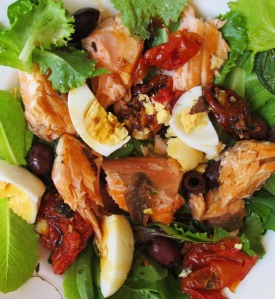
Anyhoo, the other day I slung this little salmon nicoise salad together from leftovers and fridge staples. It pretty much only took as long to make as the egg took to hardboil (around eight minutes) – and, I have to say, was very fabulous. I used vino cotto instead of making a dressing, because I can kid myself that it’s got no oil (but I bet the sugariness of it cancels out that benefit…), but any dressing you like would be fine.

This made a big salad for one, but obviously you can mix and match quantities to suit.

Reckon it’s easy enough to stick in lunch for lazy people?

  • 1 piece cooked salmon, broken into bite-sized pieces
  • 5 kalamata olives
  • 5 anchovies, roughly chopped
  • 1 hardboiled egg, quartered
  • 1-2 tomatoes (I used a few I’d roasted; they shrink a lot so used more)
  • lettuce leaves
  • a couple of teaspoons of vino cotto (or balsamic & oil dressing)
  • next time, I’d add some green beans
  • salt & pepper

Method: Chuck it all in.

h1

Getting figgy with it

January 25, 2010

About mid January each year I start stalking the grocery shelves for figs.

I’m not sure what it is about figs that just gets my blood fizzling – the textural feast, perhaps? The soft, creamy interior with that slightly powdery skin? Or maybe it’s just that I pretty much always eat them with prosciutto, and that ol sweet/salty flavour bomb is simply irresistible. And then there’s the absence-makes-the-heart-grow-fonder factor; with such a relatively short season, their arrival is cause for celebration and one is simply obliged to make a fig festival of the fact each year.

On Saturday I saw the first display in our grocer’s – of local figs that is, not Californians which have been there for a while, priced at something like four bucks each – and so of course I pounced on a big punnet of squat, heavy little beauties. That evening, before we had a chance to eat them, we went to dinner at our friends Mr & Ms Lilyfields’, and were served a fig salad so delicious that I was compelled to try to replicate it immediately the next day.

Ms Lilyfield used the classic combo of prosciutto, soft cheese & figs (I’ve used gorgonzola and other blue cheeses before – and oh, my it’s good) but she chose that amazing Persian feta, to which she added the lovely, slightly bitter, sharpness of radicchio. The finishing touch was a drizzle of luscious caramelised balsamic vinegar.

As I say, we loved it so much we tried a similar thing ourselves the next evening, and it was fantastic. So here’s my made-up copycat version. You gotta be careful not to overdo the sweetness in this, specially with the dressing. You can buy caramelised balsamic (I was given some of this last year and it is gorgeous stuff), but it’s also very simple to make. Oh and I reckon this salad would be incredible with labneh too; that’s my next plan.

Ms Lily’s luscious
fig salad with caramelised
balsamic dressing

- 1 punnet fresh figs

- 4-5 slices prosciutto, torn

- radicchio leaves

- basil leaves

- marinated feta cubes

- ¼ cup balsamic vinegar

- 1-2 tablespoons brown sugar (depending on how sweet you want it)

  1. Cut figs into halves or quarters and brush with a teeny bit of olive oil.
  2. Grill these on a tray with the prosciutto for a few minutes until the figs are warmed & the prosciutto crisp.
  3. Meanwhile, simmer the balsamic vinegar and sugar in the smallest pan you have, and gently reduce it till it’s thick and syrupy.
  4. Arrange the radicchio leaves in a bowl (or, more glamorously, on separate plates for each person) and drizzle with good olive oil.
  5. Top with the figs, prosciutto and add as much feta as you like – about three tablespoons is probably plenty.
  6. Gently mix these and the leaves together with your hands, add the basil and drizzle the lot with the balsamic syrup and season.
  7. Stand by for groans of delight.

Of course there are lots of other things to do with figs, including just popping one in your mouth for the pleasure explosion – I’m keen to hear your faves. Any fig festival contributions to share?

h1

Seeing red: my tomato crop

January 22, 2010

Just because I’m feeling proud, here is a picture of some of our home-grown Roma tomatoes.

Since this photo was taken last week, our harvest has zoomed along, and there are bowls of Romas everywhere. Gotta love a glut – it makes a girl feel sooo agricultural.

h1

Loaves and fishes: my list of miracle foods

December 15, 2009

Okay, I know Christmas isn’t strictly related to that particular miracle (reminds me of the time my heathen brother-in-law demanded of my mother what the hell Easter eggs had to do with Jesus being born in Bethlehem anyway…), but one of the things I really like Christmas & New Year holidays is the tendency toward spontaneous and sprawly gatherings over food.

You know the kind of thing, two people for lunch turns into ten, and an instant party ensues. But to make that kind of thing fun it’s gotta be stress free – so here’s my list of good stuff you can pull out at the last second for lunch or picknicky dinner, or take to a friend’s place to blast off their Christmas stress.

Some are old summer holiday faves, and some gleaned from these pages this year. Most of this stuff can be bought in advance and shoved in the fridge, freezer or pantry to pull our for miracle-working when requried…

  • Oysters - of course! Buy them unopened a few days before Christmas and keep in a bucket with a wet towel over them in a cool place – they keep for a couple of weeks.
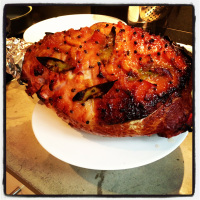
  • Glazed ham – leftovers, for weeks. Mmmmm.
  • Chutneys & pickles - years ago the Empress introduced me to the killer recipe for Christine Manfield’s eggplant pickle.
  • Smoked salmon – or Virginia & Nigella’s cured salmon! – w creme fraiche and/or salmon roe & sourdough
  • Smoked trout –  keep a couple in the freezer and pull them out any old time
  • Cooked prawns, green salad, mayonnaise
  • Bread – keep a supply of sourdough in the freezer
  • Green salad, nicely dressed with good oil & vinegar
  • Chickpeas – of course! Chuck em in a bowl with bottled roasted capsicum & marinated feta or labneh, or try these ideas
  • Baba ganoush & Steph’s beetroot dip – plus packets and packets of rice crackers
  • Quinoa salad or citrus couscous (make a huge batch – both of these keep forever)
  • Lots of luscious, ripe avocado – buy a heap of those rock hard ones now to have softies on hand for later.
  • Lots and lots and lots of ripe tomatoes
  • Devils on horseback – everybody loves them! And you can keep sealed pancetta & pitted prunes on hand for months…
  • A couple of fillets of salmon in the freezer and a couple of spuds can yield a heap of salmon patties for a crowd.
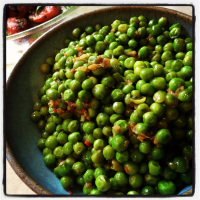
  • Peas! I am never without a huge bag of frozen peas in the freezer. Actually there will be a new post on peas coming shortly…
  • Eggs – chuck a few halved, hard-boiled eggs in a green salad with some chunks of fresh, cured or smoked salmon and you have a delicious twist on nicoise.
  • Labneh - mmmm.
  • Quiche - if you have frozen shortcrust pastry in the freezer, a quiche takes about fifteen minutes to throw together and another twenty to cook. Fast and fab.

Okeydokes, that’s Santa’s (or Jesus’s?) list of magic expandable food for now – but you must have lots of things to add …

*Oh, and today’s Christmas Excess Antidote is courtesy of www.kiva.org- I absolutely love this site. At the click of a mouse you can provide a micro-loan (as little as $25) to someone in a developing country who’s making a go of things with very slim pickings indeed. I love it so much because your loan just keeps on giving – you can either get the money back (though what kind of a person …) or choose that it goes to someone else in the chain. Perfect!

Follow

Get every new post delivered to your Inbox.

Join 294 other followers