
 Like many bloggers, I often receive offers from companies or people wanting to contribute a guest post here. I almost always decline, because it’s usually someone trying to flog some crappy product or other, with boring writing to boot. But when the excellent and generous Kathryn Elliott of Limes & Lycopene got in touch about the beautiful quarterly magazine she produces with photographer Lucinda Dodds of Nourish Me - An Honest Kitchen - I jumped at the chance. Kathryn is a nutritionist who manages to write about food with generosity and heart. She understands that cooking and eating should be pleasurable, not punitive, and her recipes and advice are always fantastic. She has also been personally generous to me in all kinds of ways so I’m chuffed to have Kathryn & Lucy’s post here - specially as anyone who knows me will recognise that a good roast chook is one of the great joys of my cooking life. Here’s a way to make it just as good but a little better for fitting into one’s jeans.
Roast dinners: a makeover
Roast dinners are one of those classic, hearty family meals. However we feel many people now hesitate to make this old favourite. Roasting a joint of meat leads to a lot of leftovers and if there’s only a few of you at home, then making good use of those leftovers can become tedious. No matter how good the original roast, nobody wants to still be eating leftovers four days later.
Plus there’s the health factor. The traditional roast, centred on a big joint of meat, with sides of potatoes, gravy and all the trimmings is a heavy, stodgy meal, one which can leave you feeling stuffed and lethargic at the end. If you’re trying to have healthy meals then avoiding the family roast may seem like a good idea.
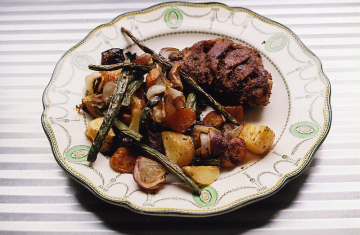
However, in our latest issue of An Honest Kitchen we’ve taken on the challenge of making over a number of meals, including the traditional roast, because we think a roast dinner can be a good thing – simple to cook, manageable even if there’s only one or two of you at home and healthy. Our Makeover has fewer kilojoules, lots more vegetables and more fibre. It’s a better balanced meal with more nutrient complexity and variety than the traditional roast
 How to makeover a roast dinner
In the course of our makeovers we developed a few guidelines which you could use to revamp your own favourite roast dinner:
- Use less meat: Rather than cooking a whole big joint of meat, choose a smaller cut with a bone in it. This will cook in a fraction of the normal time, but you’ll still end up with a juicy and flavour filled dinner. In our recipe below we’ve used chicken thighs on the bone.
- Don’t avoid potatoes: Roast potatoes are an integral part of the traditional roast and while the anti-carb movement has left them with a poor image, there’s nothing wrong with a bit of potato. It’s all about the size of the portion you eat and what else you put on your plate. Try to make the potato no more than a quarter of the space on your plate.
- Make sure you add LOTS of vegetables: Roasting is one of the best ways to cook vegetables. They are simply delicious and you can easily pack a variety of vegetables into the meal. We also avoid peeling and chop the veg into large chunks so there’s no fussy prep work required.
- Be careful with the fat: Traditionally a roast chicken is smeared with butter or another type of fat, which gives a crispy skin but is hell for the waistline. Instead we’ve actually skinned the chicken thighs and then added minimal fat in the cooking.
- Add flavour: Don’t be afraid to add unusual and strong flavours to your roast, the results can be spectacular. In our recipe below we’ve used Chinese five-spice powder, soy sauce and Chinese cooking wine to produce a roast with a difference. It’s still a roast and still delicious. This was a huge hit with our recipe testers and we’d love to share it with you.
Five Spice Roast Chicken
A twist on the normal roast chook. The whole meal is cooked on a baking tray, so you’ll either need one large tray, to fit all the ingredients, or spread them out over two smaller ones. Serves 2
- 2 chicken thighs on the bone (about 400g)
- 2 teaspoons Chinese five-spice powder
- 2 teaspoons soy sauce
- 1 tablespoon Chinese cooking wine or dry sherry
- ½ lemon
- 1 tablespoon olive oil
- 400 - 450g potatoes
- 2 red onions
- 3 carrots
- 200g green beans
Preheat the oven to 200°C.
Remove the skin from the chicken: If your chicken thighs have skin on them, then it’s easy to remove. Take hold of the skin at one end and gently, but firmly, pull it away from the flesh. You may need to use a knife to help it along. Cut the chicken skin off, using a sharp knife.
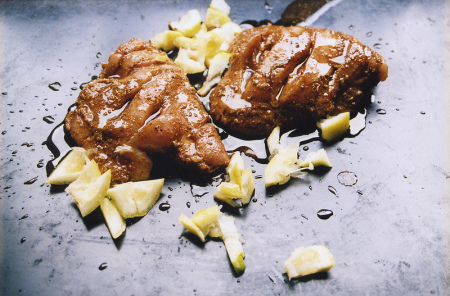
Flavour the chicken: Slash the chicken pieces all over, with a knife.You can do this quite enthusiastically, as you want each piece to have several deep cuts on both sides. Place these on a large baking tray. In a small bowl, whisk together the five-spice powder, soy sauce and Chinese cooking wine. Pour the marinade over the chicken pieces and, using your hands, rub the mixture into the chicken pieces. Make sure you push the marinade into the cuts in the chicken and all around the bone. Squeeze the juice from the lemon over the chicken. Roughly chop up the leftover lemon shell and add to the baking tray.
Add the potatoes: Cut each potato into chunks, about 4cm in size. Add these to the baking tray. Drizzle over the olive oil. Place the chicken and potatoes in the oven for 20 minutes.
Prep the vegetables: While the chicken is cooking, peel the red onion and cut each into 6 wedges. Scrub the carrots and cut into 2cm-ish chunks. Trim the beans.
Add the vegetables: After the chicken has been cooking for 20 minutes remove the baking tray from the oven. Turn each piece of chicken and potato over. Add the onion, carrots and green beans. Move them briefly and gently around in the five spice flavouring. Place the baking tray back in the oven and cook for a further 20 minutes.
Let the chicken rest: Take the baking tray out of the oven. Gently remove the chicken to a plate, cover with tin foil and leave to rest for 10 minutes. Give the baking tray with the vegetables a quick wiggle, to spread the vegetables out and then place the baking tray back in the oven, while the meat is resting. After 10 minutes serve the chicken, together with the vegetables
Cooking Notes:
Chinese cooking wine is made from rice and is often called Chinese rice wine or Shaoxing Wine. Taste-wise it’s a similar to sherry, although it has a more bitter, stronger flavour. Some supermarkets stock Chinese cooking wine and it’s also available from Chinese grocers. You can buy Chinese rice wine in many grades and a brand at the cheaper end of the scale is fine for this meal.
Chinese five spice powder is a staple in Chinese cooking. It’s a mixture of five spices, star anise, cloves, cinnamon, sichuan pepper and fennel seeds and has a wonderful aromatic smell and manages to be sweet, sour, bitter and pungent, all at the same time. Five spice powder is available from the spice section of many supermarkets. It can also be purchased from Chinese grocers.
- Kathryn & Lucy
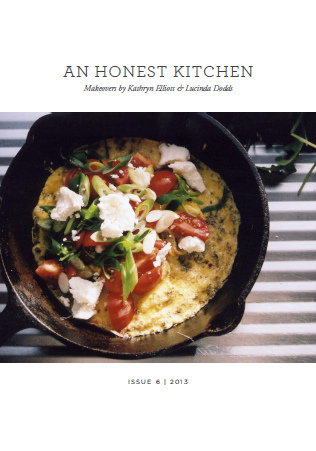 For more ideas on making over the meals you love take a look at Kathryn & Lucy’s publication An Honest Kitchen: Makeovers. An Honest Kitchen is a regular publication all about real food that’s good for you. It costs $9.95 for 31 pages of beautifully photographed and punchy, nutritionally balanced recipes - in the very friendly PDF format.
Each issue is full of simple recipes, practical cooking information and healthy eating advice. The latest edition, Makeovers, in which we revamp popular meals is available in e-format from 11 June.
http://anhonestkitchen.com.au/
 Minted pea soup

 This week, happenings in the lives of others have reminded me about the beauty of a compassionate act in the face of an unbearable thing … a dying friendship, a ghastly stranger, a rejection, an illness, a death. Back on the first aid food track I guess, food being such a simple way of making an offering - peace, sorrow, love. After I wrote the
  Have you noticed how, if you cook a meal for folks who like eating but aren’t as obsessed with cooking as One is, that they often rave about the incredible flavours you produce? I realised early in my cooking career that this has sadly little to do with how amazing the fish/snags/bombe alaska really is, and more to do with the fact that the said dish is seasoned. i.e., contains salt (and my second love, pepper).
 subscribe
 How to shuck an oyster