
 I have always been rather afraid of stir-frying fish.
I have visions of fish fillets falling apart and turning to soggy mush, making not so much a stirfry as a soupy mash. As I think I’ve discussed here before, my thoroughly inland childhood meant I came late to seafood and, unlike my beachy husband, I still lack a natural confidence in cooking much seafood.
This is one of the reasons I love Neil Perry’s recipes for cooking fish and seafood - his instructions are always so exact and clear, especially in Good Food, one of my essential books. So when I saw Mr Perry’s stir fried blue eye in last weekend’s paper I determined to look again at stir fried fish.
The recipe is for blue eye trevalla, which, while recommended for its firmness of flesh and ability to stand up to robust flavours, the sustainable seafood gurus GoodFishBadFish put in the category ‘Think Twice’. “Stocks are currently fully fished, with localised depletions. Some bycatch concern,” they say.
However, given that so much of the other seafood we like to eat is firmly in the “Say No” category, I find myself thinking that everything’s relative, and so blue eye is not so bad after all. GoodFish folks suggest alternatives of mulloway or coral trout, neither of which my nearest fish shop stocks.
I know I should ask them about mulloway, and start talking about sustainability, and “building a relationship” for future reference. But I’m weirdly, ridiculously shy of such conversations. I don’t know why, exactly. But with things like this I’m reminded of Julian Barnes’ amusing piece on food shopping in his Pedant in the Kitchen, where the author admits that for him, as for most of us, the idea of “developing a relationship” with or “instructing” one’s butcher, fishmonger or candlestick maker is as realistic as “advising” one’s local policeman or garbage collector.
This is why the Pedant’s morale is rarely lifted by a recipe beginning “Instruct your butcher to…” or “Telephone your fishmonger in advance and ask…” Now I know some excellent butchers, fishmongers and fruit ‘n’ veggers, though I don’t think of any of them as “mine”. Equally, I sometimes encounter a needlessly surly butcher who, when you hesitantly propose what you might require, will seize something in a flurry of hands, offer it for a nanosecond’s inspection with a lip-curling “That do?”, and have it on the scales and off again before your eyes can refocus, while calling out a weight and price which could well be a touch speculative.
I can imagine the look of bafflement on my fish shop man’s face if I quizzed him on his sustainability credentials. I suspect it would resemble the response of the woman behind the counter at a terrible local store laughingly called a “deli”, when I asked her about the origins of one of her four slabs of unmarked, unlabelled cheese. “I dunno,” she said, crossly. I tried again, valiantly. Might she know what kind of cheese it was? She sighed, cast her eyes to the ceiling, and shot me a look of undisguised contempt as she said: “English”.
Sometimes I wonder if avoiding this kind of exchange is part of the reason some people actually prefer supermarket shopping. (It’s also one of the reasons, apart from the amazing quality of the meat and the ethical aspects, I buy almost all our meat from Feather & Bone - they actually do like to talk to you, are happy to help, and are generally Lovely Humans.)
Anyhoo, back to fish!
I bought blue eye trevalla from my surly fish man, and with it made a bastardised version of Neil Perry’s recipe last night. I marinated the chunks of fish as per his recipe, but from there returned to the old faithful stir fry combo taught to me a thousand years ago by my friend Ricardo: red capsicum, lots of sliced garlic, 3cm batons of green onion, a couple of birdeye chillis, split lengthwise, and then half a bunch of basil leaves tossed in at the end. Add to this a goodly slosh of fish sauce (I tend to go for at least one tablespoon, sometimes more) and a good pinch of brown sugar.
Method wise, I began as Neil suggests:
1. Heat a wok with a little vegetable oil until just smoking, then add the fish pieces with the marinade, spreading these evenly around the wok.
2. “Cook undisturbed for 1 minute, allowing the fish to start to brown” - then I turned the chunks once until almost cooked, then removed them and set aside.
3. I then added the vegetables but not the basil to the wok and stirfried them for a few minutes (adding a little boiling water), then returned the fish, slooshed in the fish sauce and brown sugar and gently stirred to combine, still at high heat.
4. As I turned off the heat, I threw the basil leaves in, put the rice in one serving bowl and the fish in another. By this time the basil leaves had wilted just nicely.
It was excellent.
Do you stir-fry seafood much? any problems? And what about “your” butcher, fishmonger or baker? How do you begin the conversations I’m too chicken to have? I would really love your views.

 Smash it up: Jared Ingersoll’s crab & harissa soup
 Suffice it to say that if you want to make this soup, you must prepare for a splatter fest, given that the smash-up here involves not only crab but a soupy mix of roasted capsicum and onion and tomatoes. I started out trying to prevent crab on the ceiling by leaning over the pan and hoping my apron would take the brunt, but eventually I just gave in and bashed away with the rolling pin, picking bits of crab and roasted capsicum and tomato off the walls and my face as I went, pitching the bits back into the pan as best I could. I even confess to a certain amount of pleasurable abandonment to the process after a while.
 If all this sounds like one giant headache, it kind of is. But the result, I must tell you, is pretty fantastic: a deep, velvety, richly spicy soup. The quantity, which looked small when we finally had the soup finished, was just right - it’s so rich and luscious that a little goes a long way. This recipe comes from the book Sharing Plates, which is full of good stuff including our favourite
 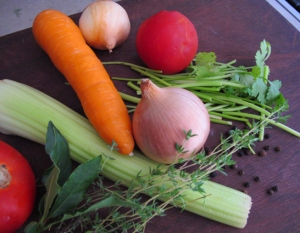 Regaining your kitchen mojo: the chicken stock method
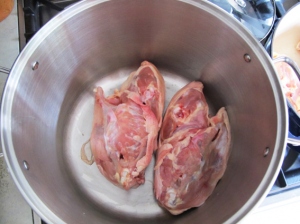 This was partly inspired by my cooky brother-in-law (one of several!) marvelling recently over why people pay good money for tetra-paks of stock full of salt and perservatives when chicken stock was quick and so simple to make. I confessed I was one of these ninnies; I had not made stock for months, and I often use those cartons (my view remains that using packaged stock is pretty far down the list of culinary sins, so I have no problem with it).
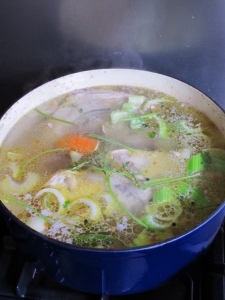 Second, the sensory delight of this little job is immense. For one thing, there’s the luscious smell - our front door was open to the street when I made mine, and I actually saw passers-by stop and peer into my hallway, provoked by the cooking aroma. Then there’s the visual beauty of it - the glistening little baubles of fat separating and rejoining, the gentle steam, the gradual transformation of your wan bunch of ingredients into a potful of golden goodness.
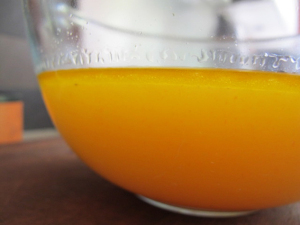 I have mostly made stock by bunging the leftover bones from dinner into a little saucepan with the veg trimmings before the dishwasher is stacked, then simply turned off the heat before going to bed. Recipes are everywhere and recommended simmering times vary anywhere from twenty minutes to four hours, so it’s pretty much a no-brainer, deadset simple thing to do. But I have to say there is a leisurely pleasure in the long-simmered type that doesn’t really shine through so much in the quick apres-dinner simmer. For me, anyway - I welcome dissent on this!
 Happy New Year everyone. I hope you are all still on languid holidays involving lying about reading, dozing, or foraging in the fridge for feasts of lazy food. And if you’re back at work, may the holiday feeling continue just a wee bit longer.
 We all know from crappy holiday house kitchens that there’s nothing worse than a blunt chef’s knife - the kind you end up bludgeoning, rather than cutting, food with - and I take care to keep ours reasonably sharp. But the other day, as I end up doing only every few years, I had six of our knives professionally sharpened. Man oh man, what a difference.
 Step 2:
 Step 3:
 Step 4:
  The result:
 Don’t get me wrong, I love tofu. In good Thai and Japanese restaurants, or when somebody skilled cooks it for me. Agedashi tofu is one of my favourite things in the world. And at our favourite Thai, the beloved Ploy, there are a couple of tofu dishes to die for - one stir-fried tofu with bean sprouts, and the other a divine larb tofu salad.
 I dried and fried the tofu cubes first, then drained them on kitchen paper - then did the rest of the stirfry and then tossed the tofu back in at the end with the fish sauce and basil. The result? Pretty damn fine! So here is the befuddled recipe, which can obviously be mixed and matched and altered as you wish.

 subscribe
 How to shuck an oyster