
 Apologies for my absence here lately. I am nearing the pointy end of editing for my novel Animal People, with the finished copy-edit due back at the publishers Friday week. It feels like the last chance to really get it as right as I can make it, so am sweating over each line again after considering the larger shape of it for a good while. Hence, little time for dropping in here, which I regret. Today’s recipe is a cross-post of something I wrote a few weeks ago for Murdoch Books’ 365 Day Challenge blog, in which various home cooks test recipes from Stephane Reynaud’s 365 Good Reasons to Sit Down & Eat. My first dish (two more to come) was this cured salmon. I’ll be back soon with some Indian vego stuff I’ve been making lately from another new book I’ve discovered, which is making me swoon. But until the novel is done it’s back to the book for me …
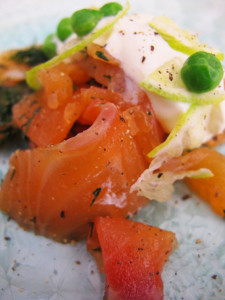
Cured salmon with peas
Cured salmon, or gravlax, has to be one of the most impressive dishes a girl can make in terms of bang-for-the-effort-buck. Apart from the curing time, which varies in recipes from 24 hours to several days, the actual preparation and garnishing time is around ten minutes max.
While other recipes often include vodka or gin in the curing mix, Stéphane’s cured salmon only uses sugar, salt & dill, and it worked just fine for me. As I was making it for two, rather than six, I just bought a single thickish salmon fillet (about 400g) but used the same amount of curing mixture as the recipe recommends for 800g; the result was fine and yielded plenty for snacks and light lunches.
For the preparation, all you do is mix a tablespoon each of coarse salt (I used ordinary cooking salt), coarsely ground pepper and sugar with one bunch of chopped dill together in a bowl, and then smother the salmon fillet in this mix.
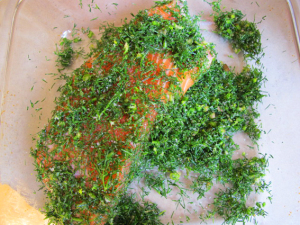 Then comes the waiting. Stéphane says leave the salmon in the fridge (I’d recommend in a glass or ceramic dish) for 48 hours for it to ‘purge’ – to remove the water content in the salmon, concentrating its flavour and sort of toughening up the texture. Because we were out in the evenings a lot this week I ended up leaving the salmon for another 24 hours on top of the recommended 48, and liked it very much. I think perhaps for my taste 48 hours might not be quite enough, but it really is a matter of taste I reckon. The longer you leave it the dryer it gets, the stronger the flavour – and perhaps the thinner you should slice it.
Once the curing time is up, take out the salmon and pat it dry with paper towels and slice. Stéphane recommends serving thickish pieces – 5cm in fact – but once I tasted it I preferred it very thinly sliced, as we’re used to eating with smoked salmon. It’s very rich, so paper thin shreds are delicious.
I really loved Stéphane’s addition of the shaved bits of shallot and lime, and the peas. As I was in a rush to serve I couldn’t be bothered zesting, so I just sliced the lime as thinly as possible and then quartered the slices, leaving the skin on. I also used thick, Greek-style natural yoghurt instead of the recipe’s combined olive oil & crème fraîche, which sounds amazing – but if you’re trying this for healthy midweek cooking, as I was, could be a little too sumptuous. The lazy cook in me also prefers frozen peas (I can’t get enough of them) so used frozen peas pinged in the microwave for half a minute instead of fresh peas.
The flavour and texture combo of the silky salmon, the soft peas and yoghurt with the sharp, slight bitterness of the lime and shallot was fantastic. I’ll definitely be doing this little baby again sometime – as a beautifully simple starter, for starters, or tumbled together as an addition to a table full of salads. A big tick for this one from me.
This post first appeared here …
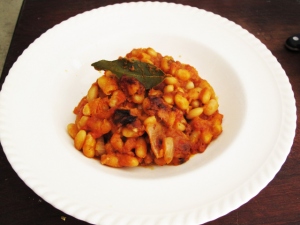 You may recall that following our highway harvesting a couple of weeks ago I found myself with a kilo of fresh borlotti beans and no idea what to do with them. Until I asked good old Twitter for ideas (so useful for a quick shout-out, that place) and @BZB suggested Boston baked beans - bingo!
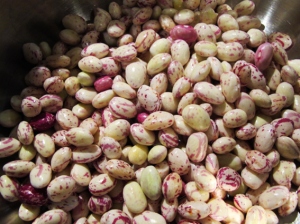 With our lovely fresh roadside borlottis (pictured podded here) there was no soaking involved, obviously. In fact despite being a bit unsure of what to do, I just tossed them uncooked into the saucy mix and baked them for several hours - while I was off attending a pro-carbon tax rally, to be precise. And let me tell you, there’s nothing like a bit of good old-fashioned sign-waving, foot-stomping, slogan-shouting protesting for working up an appetite for these babies! (and no, I won’t be sullying this blog with the gags about gases and emissions that are just begging to be made right here; you’ll have to enjoy those in the privacy of your own home…!)
 Sometimes it’s difficult not to feel swamped by the grime and aggression of urban life (not to mention the deeply depressing nature of ghastly world events - sorry about that dispiriting last post, folks). If you live in the inner city, as we do, you may be faced with a constant barrage of noise from cars, leaf blowers, power tools, garbage trucks, street sweepers and aircraft. And if you live near a dodgy shopping centre, as we do, you may also be treated to various instances of human aggression floating in through your open windows as people pass to and fro. Shouting, spitting, swearing, parents screaming at their kids, kids at each other, young men at young women and vice versa - there are days when city living just becomes too much.
 Happily, this urban stress syndrome (I believe it’s official now) can be quickly alleviated by a drive into the country. Last week we spent a night with friends at a house on the Hawkesbury River, only about an hour and a half away from home. Sitting on that verandah early Saturday morning watching the river was the most restorative tranquilliser I could have wished for at the end of a long week.
 There’s a human connection - a warmth - in this passing of basic, simple food from their hands to yours that I find deeply soothing.
 Anyway - by the time we made it home from the Hawkesbury we had a dozen fresh eggs, two kilos of beautifully ripe tomatoes, a kilo of borlotti beans and two kilos of figs.
 We still have about a dozen very ripe figs left, so this weekend I’m going to throw a few into
  subscribe
 How to shuck an oyster