In which practice actually does make perfect
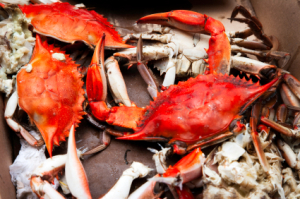 Flicking through the recipe books in search of something special for a friend’s birthday dinner the other week, I happened upon Damien Pignolet’s crab soufflé. But I soon grew daunted by the gazillion steps, and then breathed a big sigh of relief when I remembered one of our guests can’t eat gluten, as the soufflé had flour in it. Then another idea struck: crab mousse! Retro enough to be surprising - or possibly raise a laugh - but I figured it would also involve just enough velvety lusciousness and feel-the-love effort to make a birthday girl feel special.
Next step, hello internets. My friends, there are so many bad recipes online, have you noticed? Obviously there are squillions of brilliant ones too (*bats eyelashes*), but lordy me. Google ‘crab mousse’ and you will find yourself immersed in more lists of cream cheese, powdered onion soup, gelatine, emulsifiers and other icky goop than you can poke a whisk at.
Happy was I, then, to find this baked crab mousse recipe from Tamasin Day-Lewis. But never having baked such a thing as mousse before I decided, most uncharacteristically, to give it a practice whirl a few days before the birthday do. Usually I don’t bother practising, being blessed with forgiving friends who are usually happy to be experimented upon and whose manners are impeccable even when served less-than-fabulous meals (Ms A, I’m thinking particularly of you and the grass-clippings chicken a short while ago - you were a model of composure).
Anyhoo - in this instance practice was a good idea. The first time I made the recipe I kept the oven at its standard fan setting, but it was too hot. I also used the recipe’s method of covering each mousse with greaseproof paper but that was a total dud idea for us, as the paper simply curled up, and given the hot oven the thing began to brown round the edges, which is not what you want on a delicate, pale, crabby moussy thing like this. Also, served after five minutes as recommended was way too hot. And finally, presentation-wise it tended to look a little wan and needed a bit of bling. However, the texture was not bad and the flavour was good. So good. So very good.
On the second attempt - birthday dinner day - everything went swimmingly. I used foil to completely cover the ramekins instead of the paper; I turned the fan function off on the oven; I cooked the mousse a little longer and let them cool for longer in the pots. And as a garnish I added a blob of creme fraiche with torn dill and a teeny dollop of caviar. And I am here to tell you it was good. The birthday girl loved it and so did we.
Baked crab mousse with dill & caviar
Adapted from Tamasin’s Great British Classics
Serves 6
Ingredients
- meat picked from body & claws of 4 cooked blue swimmer crabs, or about 250g crab meat
- 4 eggs, beaten
- 400ml thickened cream
- 4 tsp dry sherry
- 2 tsp Dijon mustard
- biggish pinch cayenne pepper (be careful - taste at half a pinch first)
- 2 tbsp finely grated Parmesan
- 6 dollops of creme fraiche
- a few fronds of dill
- caviar or salmon pearls
- salt & pepper
Method
1. Preheat the oven to 170C. If you have an adjustable fan setting, turn it off or to lowest setting.
2. Lightly grease 6 small ramekins.
2. Puree crab meat, eggs, cream, pepper, mustard and sherry until smooth.
3. Stir in the Parmesan and season to taste.
4. Spoon the mixture into the prepared ramekins and cover each with a round of aluminium foil.
5. Sit the ramekins in a roasting pan and pour enough near-boiling water into it to come halfway up the sides of the ramekins.
6. Bake for 25 minutes and check. If they are still very wobbly in the centre, keep cooking for another five or ten minutes. The centre should be just lightly set.
7. Remove pan from oven and leave on the stove top, leaving ramekins covered in the water bath until ready to serve. I left them sitting for a little over an hour, and the temperature was perfect - just slightly warm is the perfect temperature.
8. Remove foil lids, wipe away any condensation from the rims and top each one with a dollop of creme fraiche, a tiny spoonful of salmon pearls or caviar and a teensy frond of dill.
9. Serve with champagne & teaspoons.
In this case, practice made (almost) perfect, and I’m glad I did the test run. I doubt I’ll take up testing recipes first on a regular basis - who can be bothered? - but would love to know if you do. Are you a routine practiser or do you use your friends as guinea pigs? Any fabulous disaster stories? Do tell.
 I was recently reminded about the earthy beauty of tea-smoked fish by that television show.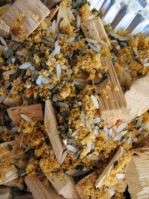
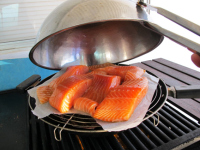 Next, get the fish on a wire rack. The video advises putting the fish on baking paper first, which we did the first time, but didn’t bother the second time. Again, I think best is maximum circulation of the smoke and our quantity of fish meant the paper worked as another barrier between the heat & smoke and the fish. So on our second attempt I simply oiled the rack to ensure non-sticking, which worked fine.
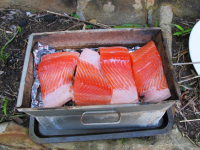 Which brings us to the great advantage of the smoker box - the seal, made by a sliding lid, is very tight and the tray is very close to the mix itself. Slight drawback for us, in cooking for ten, was that we had to do two batches. But then again, that allowed a couple of different levels of smokiness which allowed people to choose which flavour they liked best from the platter.
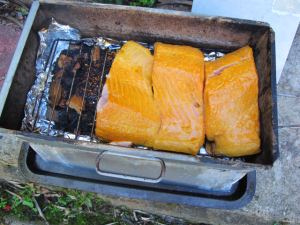 Here is the smoked fish after about eight minutes in the smoking box - highly smoked on the outside, but a couple of pieces were quite raw beneath the exterior. Another five minutes or so in the oven fixed that, but several pieces were just cooked through enough to leave as they were.
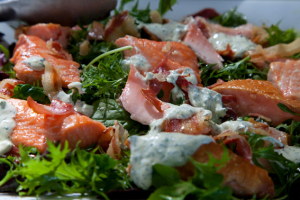
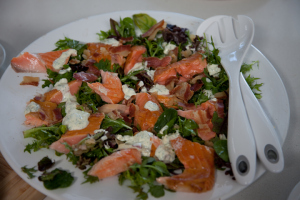 So, once your salmon - or trout, or ocean trout or I imagine even chicken or whatever else you fancy! - is ready, all you need to make this salad is some good springy green leaves, some crisped bacon, pancetta or proscuitto, and a creamy dressing we made this time with creme fraiche, fresh horseradish and finely chopped dill, salt & pepper. A mix of good Greek-style yoghurt, dill and horseradish cream would do just as well. I dressed the leaves first in my standard three-parts-oil-one-part-balsamic vinegar dressing, then over that arranged the chunks of salmon, then topped with the bacon and a few dollops of the creamy dressing (keep the rest in a jug on the side - believe me, it’ll go).
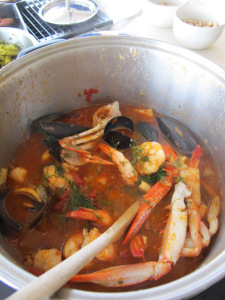 Sunday lunch in winter is a very fine thing, and a big pot of shellfish stew has gotta be up there as one of the easiest ways to make it happen. I don’t think I’ve ever made a proper bouillabaisse according to a recipe, but over the years various versions of this fishy number have made their way to our table.
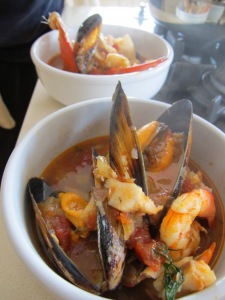 Peel & devein prawns, leaving tails on and setting aside the shells & heads.
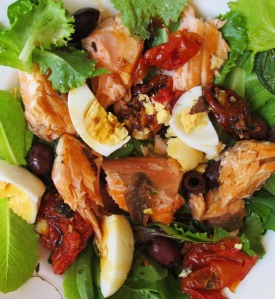 I don’t know about you, but whenever I unwrap a salmon fillet these days it seems to have grown to twice the size it looked in the fish shop. So I’ve started cutting them in half after barbecuing - the easiest way to cook salmon, I find - and keeping half in the fridge for lunch.
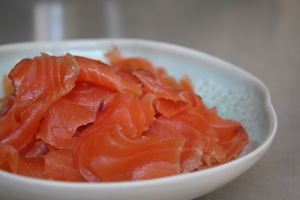 I try not to hang round on Twitter too often, as whole days can whiz by while I’m distracted by shiny baubles, but sometimes you can find gold there - like this easy wasabi & sake cured salmon.
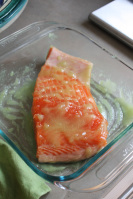 The recipe here says you can leave for up to five days, which I did because we were out for a couple of nights in a row after the third day. Yesterday I unveiled and sliced the salmon up and it is delicious.
 As I passed the excellent
 The Empress Clifford-Smith turns her attention to small and salty fish in her column this week - and oh my, how good does that little sardine number from the Burlington look?
 subscribe